Visiting
Ulfa - Wednesday, 12 July 2000
Return
to trip outline
Return
to Holt family page
by Mabel Busdieker -- photos can be seen at the
bottom of this page
At 6 am at the Rueduhiem Schloss we got an automatic wake up
telephone call. We got dressed, packed up our suitcases and put them
out in the hall for the hotel porter to pick up and take to our bus.
Then at 7 am was breakfast time - a nice buffet with ham, bacon,
scrambled eggs, hard rolls, pastry choices of cereal and my favorite
fruit assortment - especially the slices of fresh pineapples. By 7:45
we had walked two blocks to the place where the bus was picking us
up. The streets near the hotel were so narrow that no bus could drive
to it, but it was a lovely hotel with garden nearby.
On the bus the ten of us bid goodbye to our Tour Guide Elizabeth
at the Frankfurt airport after a two hour trip from Rüdesheim
through the rolling hills of grain fields interspersed with trees
passing by the Wiesbaden American Air Force permanent Station. The
bus dropped us off at the Inter City Hotel near the train station. We
checked in our suitcases, got our free public transportation passes.
At eleven o'clock Ray, Celia, Lyle, Ruth and I searched for the right
train to take to Friedberg -- In that town we walked several blocks
but found no toilet and no cafe. Ray bought 5 chicken wings (5
flugel) from the back of a truck. We noticed a train was parked on
the track. It said Nidda which was where we needed to go next. We
were the only people on the train, we each ate a chicken wing and a
package of wheat crackers with cheese, drank our bottled water as we
rode through the country side. We saw several herds of sheep, a few
cattle in a creek side pasture, nice riding horses occasionally, but
mostly we saw vast stretches of rolling grain fields, wheat rye and
another grain. Later we found out this "other grain" was rapes: the
young plants are yellow flowers, later it resembled wheat only it
contained smaller seeds like oats plants. Perhaps the spring crop was
still yellow, whereas the winter crop was ready to thrash now. Rapes
is thrashed and crushed for oil to use for table or auto fuel or
heating fuel. It's been very cold and wet so harvest is late. Most
combines were small yellow, red, or blue. One green 6600 John
Deere.
At Nidda we got off the train, went underground and up to reach
the bus just before it left for Ulfa. This bus (with the five of us
and one other passenger) wound its way through some wooded areas
where trees were so tall they touched each other above the bus, but
also plateaus where the road seemed to be on a high area so we could
see on both sides acres of rolling fields of grain like a patchwork
quilt. No fences and no animals and no buildings were in sight
anywhere. Just what would Ulfa be like I wondered.
We had been told there were three bus stops in Ulfa and that the
one Ulfa "Denkmal" monument was the one nearest the church. As we
stepped off the bus there was a large memorial monument with many
names inscribed of those who'd lost their lives in wars. Across the
street from the monument was a big old stucco building with a sign
Evangelical Church on it stating the times for worship services, etc.
Ruth took a picture of this building thinking it was the church but
later learned it was a school building. The church was on up the hill
and had a tall fence around it. As we walked along the street we
noticed inside the locked gate was a flight of very steep steps
leading up to the front door of the church. Gates were all locked
except a children's playground near the church. So we went in there
so Lyle and Ruth could take some pictures of the church. It was 1 pm
when we got to Ulfa and by talking to a man in a yard Ray learned
that all businesses are closed every Wednesday afternoon and through
a phone call the previous day we knew the Pastor Frau Otto would not
be there to unlock the church until 5 o'clock. So we had four hours
to roam the streets -- tavern, bakery, etc. all closed. Luckily Ray
talked to a man who invited us into his house to use their toilet and
at a table we were served some apple juice, showed some pictures of
the yellow growing grain crop. This man, Mr. Gottwalz worked at the
bank so had the afternoon off. Ruth brought out her genealogical
charts and we chatted about families they knew whose names were on
the charts. They told us about friends and relatives who either live
in the US or who had visited there. I had seen their name Gottwalz on
the early 1800 records where I found the Holt baptism and marriage
records. They agreed the name Gottwalz had been in Ulfa for a long
time.
While we were at the table the phone rang. Cheerfully the caller
was told that they had company--Americans were visiting. Mrs.
Gottwalz had her shoes outside the door--she'd been weeding her
flower garden it seemed. When we left she went back to do that.
The five of us started walking up the street until we came to a
sign that said "Willkommen"meaning welcome to Ulfa. Flowers were
nearby. Ruth and Lyle walked farther up the hill from where they took
photos of the surrounding countryside and fields, where perhaps our
Holt ancestors worked as farmers between 1805 and 1847. In recording
births and baptisms the fact was always stated that the father was a
farmer from Ulfa, so I presume they lived in the village and worked
in the fields around there.
The southernmost outer street was named "Eselweg" meaning donkey's
path. It is now a very modern hard-surfaced street with large new
homes along it. Near one of the homes were a few pens with sheep or
goats. As we turned the corner northward, we came by playgrounds with
small children, and in the street were older boys appearing to be
practicing their soccer skills.
This was in a low level area of town and could have been the area
where Ulfa got its name. Oloffe (original name of Ulfa) meant
marshland. Near here we saw a small building with the sign
"Volksbank". That apparently was the "People's Bank" where Mr.
Gottwalz was employed. We came to another bus stop. It appeared to be
a teenage gathering place because there was a small group of bicycle
riders talking to each other. Since the names of the two remaining
bus stops were "Molkerei" (Dairy) and Ulfa Kindergarten, I imagine
that this bus stop was "Molkerei" because as we walked along we came
past some large typical German homes with big barns
attached--definitely the older historical section here in the heart
of the village, which had very likely housed many milk cows each
evening in the years gone by. Now some open doors revealed stacks of
wood or machinery but we saw or heard no animals.
As we headed in a westerly direction up the hill toward where we
thought we could find the church again before the clouds decided to
sprinkle some of their moisture on us, we were glad to rest
occasionally on a bench on the sidewalk. One bench said Volksbank on
it.
We met several grandmas each pushing a grandchild in a stroller. I
started a conversation in German talking about the nice weather and
why we were strolling along. Everyone we met was quite friendly.
Occasionally someone would pop their head out of the second story
window and join in our conversation and evidently telephoning others
to spread the word why we were in town.
Once while we were resting on a bench, someone from about 100 feet
away motioned and called for us to come down to their house. A lady
introduced us to her mother, an 89 year-old-lady who had some
information to share with us. She invited us into the home which she
shared with her husband and her daughter and son-in-law. The older
lady said that she had not known any Holts but had heard of some
other names that were in our genealogical files. She also shared her
ideas of things important in life. At one point in our chat we talked
about flags of the various German provinces. Ray wanted to be sure
that they meant flags and not coats of arms, so he asked about that.
The German word for coat of arms is "Wappen" and the lady thought Ray
had said "Waffen" the word for military weapons. She said Oh, No,
that she had lived through two wars in Germany and she did not want
that to happen again. Her daughter let her know the word Ray had
used, but the conversation continued on that topic for a while. Ray
mentioned that people from different countries getting to know each
other would help avoid war. She said "Yes, and we all have the same
God." Her husband said they had had 2000 chickens at one time in
addition to other animals, but he had to go to war and his wife with
3 small children could not carry on with all the work. Things were
never the same since. We were told most of Ulfa's residents now
worked in near-by towns and some did a little farm work in the
evenings. As we left I heard some pigs squealing as though they were
being fed--perhaps by the son-in-law. A pile of manure was nearby .
It had evidently been forked out of the hoghouse and waiting to be
hauled away. We saw a few small tractors and wagons being driven
along the street, but very few cars.
While we were waiting for the pastor at the church--a lady came by
with her young grandchildren on the way to get some ice cream she
told me. They waited at a certain intersection but the ice cream man
never came by, so they played in the church's playground instead.
A little after five o'clock a young lady came towards the church.
She was the pastor "Frau Otto" who unlocked the gates and church door
for us. Most urgent of all was that she unlocked an outside door
which led to a basement toilet, which we took turns visiting. While
Lyle and Ruth used their cameras to capture the unique interior views
of the Evangelical Church at Ulfa, Pastor Otto told the rest of us
that she preaches at this church every Sunday and also at a church in
another town.
She gave me back the letter I had sent to her in March telling her
that I was looking for baptismal records of Conrad Holt. She said she
did not answer my letter because she could not read the old time
German handwriting and the record books were so old and flimsy. She
was surprised when I told her that Ulfa's church records had been
copied and put on microfilm and viewable at the LDS Family History
Library in a town near my home. She was amazed that I had found 17
baptismal, marriage, and death records of Holts including direct
ancestors of Lyle and Ruth. These were recorded between 1796 and
1847.
The sheet of information the pastor gave us told us that Ulfa in
1940 was a place of about 1100 residents in the vicinity of Schotten.
The sheet was entitled "Where Hangs the Oldest Bell in Hessian
Evangelical Churches?" The answer was it hangs in the steeple of the
Evangelical Church in Ulfa. It was cast in 1334 according to the
inscription on it. Perhaps the old bell tolled while Conrad's
grandfather married Elizabeth Ludwig in 1796, and later when Conrad's
Great-grandfather in 1813 and his grandfather in 1822 were carried to
their final resting places. Because the bell is so old, it is now
only rung on Christmas and New Year's Eve. Newer bells are also in
the tower and rung every Sunday. The sound of chiming bells came from
the church tower every hour while we were nearby.
Ruth snapped a last minute photo of the north side of the church
building , just in time for us to catch the 5:45 bus to Nidda, then
the train to Friedberg and then the S-bahn to the main Frankfurt
train station. Our day concluded with a late evening meal at
MacDonalds and sharing tidbits of our day's unbelieveable experiences
with others at the Intercity Hotel.
Another account of the
day
translated
Ulfa history from internet
PICTURES
(click on photo for better view)
Return to top
Friendly Welcome to
Ulfa
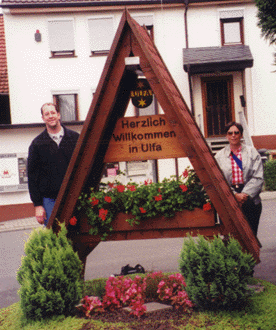
Lyle Rosburg and Ruth Busdieker entering Ulfa, the home of our
Holt forefathers -- ggggg & gggg & ggg & gg all lived
here. Our gg grandfather Conrad Johann Holt left here, arriving in
America 17 June 1853 at age 22.
Return to small photos
The Evangelical Church in
Ulfa
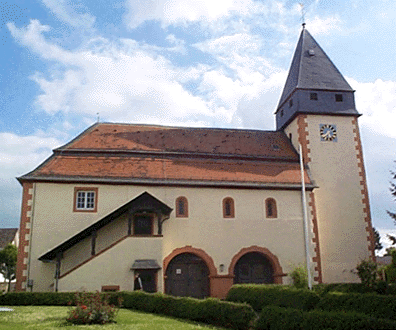
The birth, death, and marriage of many of my Holt ancestors were
recorded at this church from 1796 to 1847. This church was in the
middle of Ulfa on a hill. Most of the residents in Ulfa are
protestant, this was the only church in town.
Return to small photos
The back of the
church
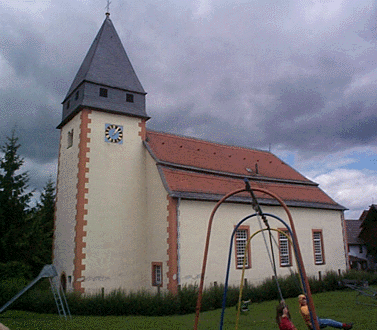
There was a playground behind the church. The gates around the
church were all locked. The playground was open for children to
enjoy.
Return to small photos
The Steeple
|
|
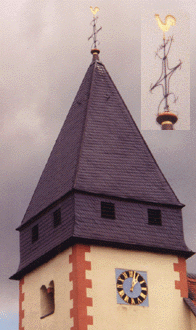
The rooster signifies a protestant
church. Inside this steeple is the oldest
bell in the region, being cast in
1334. Now the bell is rung only on New Year's
Eve.
|
Return to small photos
The Playground
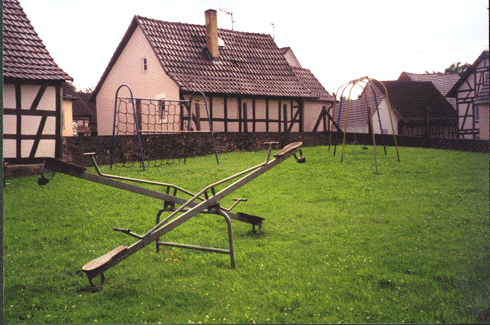
The playground and houses behind the Evangelical
church.
Return to small photos
Inside the church
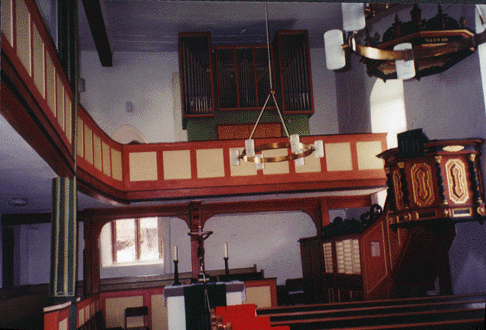
The organ on top, high pulpit to the right, alter in
front
Return to small photos
Inside the church
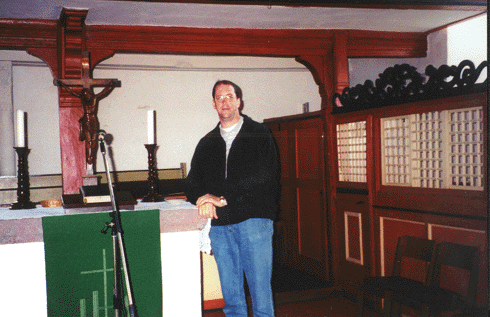
Lyle at the alter in the Evangelical Church in Ulfa. The church of
his Holt ancestors
Return to small photos
The Gottwalzs
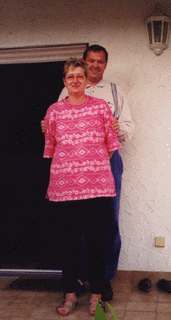
Upon entering Ulfa by bus we discovered that all businesses were
closed on Wednesday afternoon. We had a four hour wait before Pastor
Frau Otto would open the church so we could view it inside. These
people invited us into their house for drink, use of their "toilette"
and some conversation.
Return to small photos
A view from Ulfa
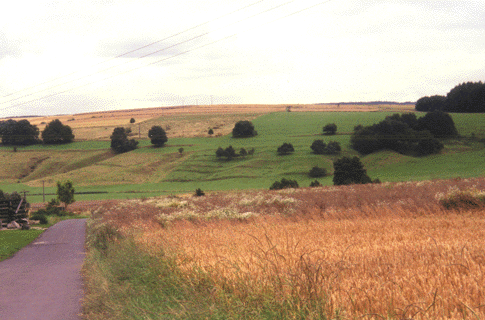
Ulfa was a village,. surrounded with views such as
this.
Return to small photos
A typical barnyard
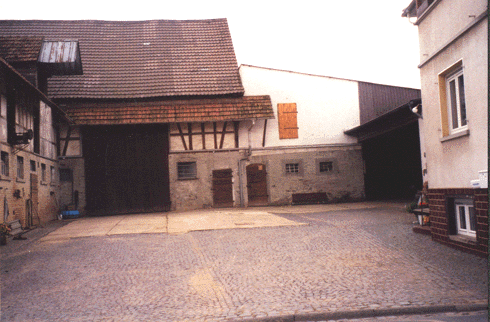
This was a typical family dwelling in the center of town. House on
the right, barn to the left and rear. Frequently two generations
would live in the house. Things were always clean, tractors were
small, 25 horsepower or less. We were told there were only two full
time farmers in the area. Most in the town commuted to Nidda or
Frankfurt for employment. Some people would have a few horses outside
of town. The outer ring of town were newer homes, immaculate with
many plants and/or flowers.
Return to small photos
The newer part of
Ulfa
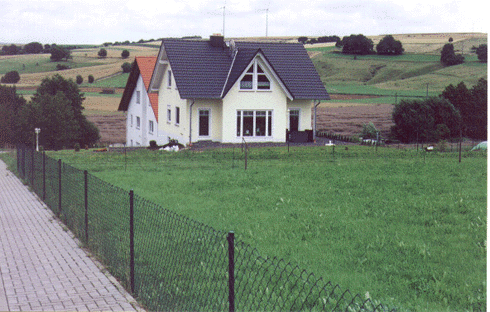
These houses were typical in the outer newer parts of
Ulfa
Return to small photos
Leaving
Ulfa
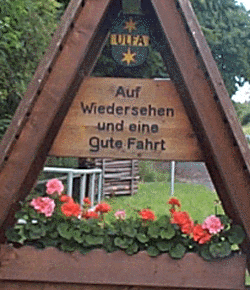
Good-Bye and have a good drive
Return to small photos
Return to
top


