Lydia Welge
protrayed by Marcia Behr|
|
Lydia Welge
protrayed by Marcia Behr|
|
Lydia Welge
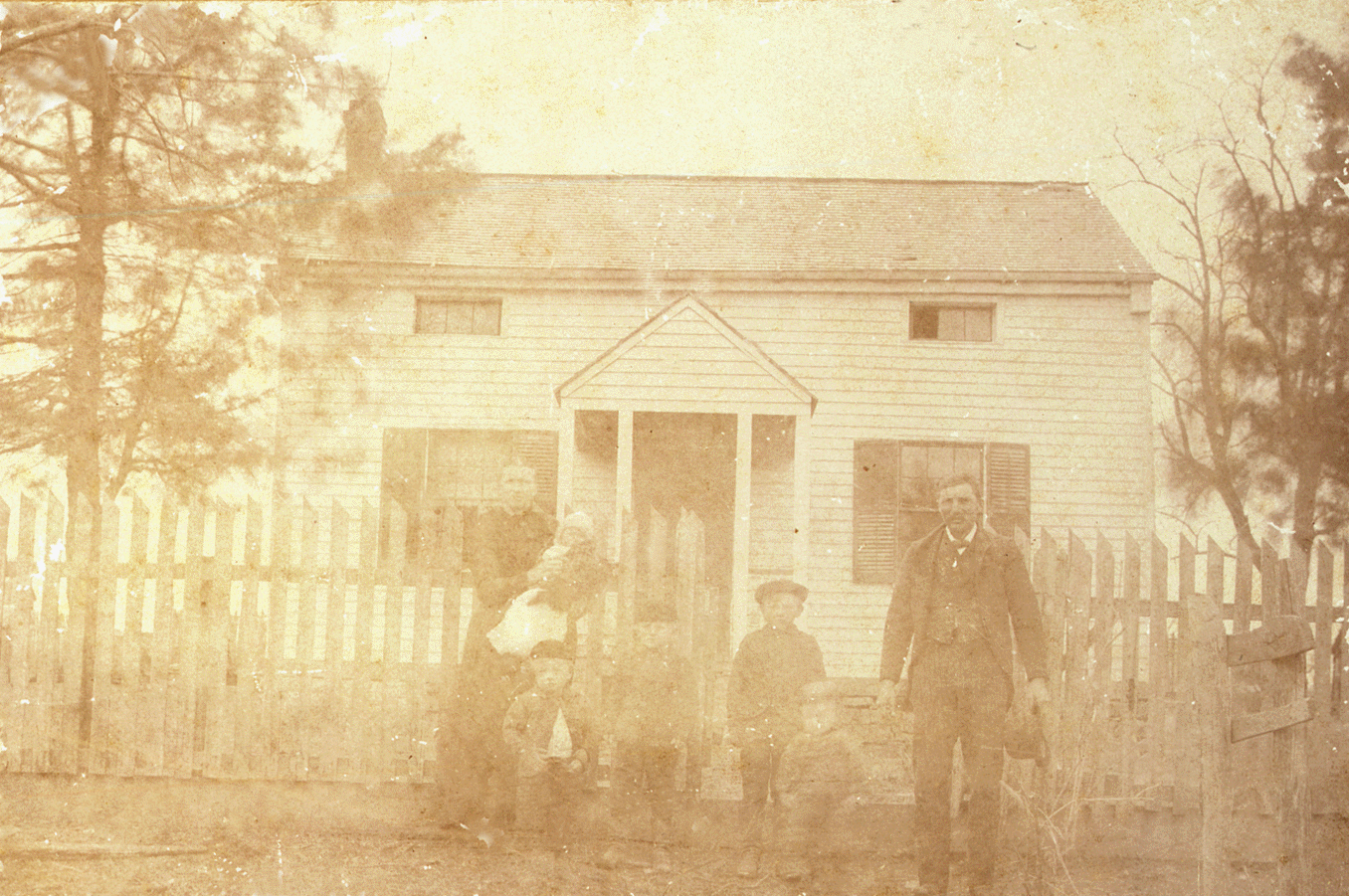
My name is Lydia Welge, I want to talk to you about my brother Emmet and me. Here is a family photo taken in 1893. I'm the baby in my mother's arms, Emmet is in front of the picture. We were the 3rd and 4th child born to Fritz and Juliana Welge. We lived in what would most recently be called Adele Welge home on Highway T.
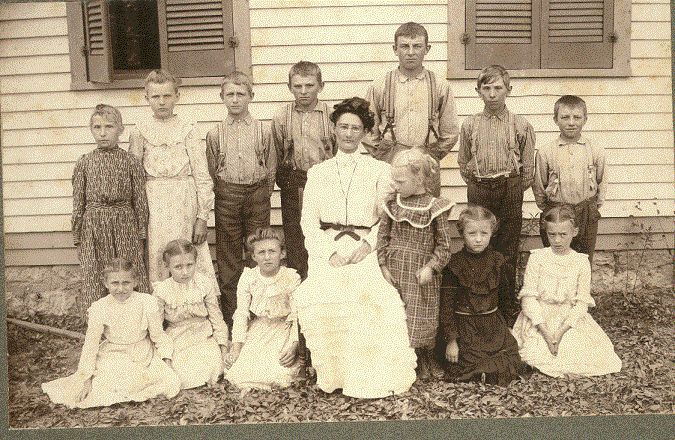
Our grandfather "Henry" came with his first wife from Lower Saxony part of Germany in 1851, at the age of 31. Nine years later his wife died and later he married my grandmother "Catherine" who came from Melle, Germany. Our parents were both born here in Cappeln area, & their marriage is recorded in this church. We were normal siblings; our family spoke German. My siblings would go to English speaking Liberty Grove School and the German Church School at Cappeln. Liberty Grove School, which would now be on the Schnarre farm in Warren County. We have no school pictures of Emmet & I. However here is a picture of my Younger brothers and sisters at Liberty Grove around 1910. My twin brothers Arthur and Alfred are on this photo.
In March, 1901, Emmet & I got Diptheria. I'm going to put on my BIG GIRL hat now and tell you a little about that awful disease… It is a bacterial infection that is spread when a healthy person comes into contact and ingests the respiratory droplets of an infected person. You know, the sick person coughs or sneezes…and some of those droplets, either big - like mucus or tiny - like just a part of their breath…is inhaled or touches the eyes, nose, mouth, or even ears of another person.
As the disease spreads through the body, the bacteria make toxins that cause a thick, tough layer of film to form in the nose, mouth and throat of the sick person. This film eventually gets so thick that it closes off the airways and people can’t breathe. As early as the 1600's, Diptheria was known as the, "strangulation" disease. It was pretty awful. The toxins can also cause severe damage to the heart and other internal organs…thus leading to death.
Our parents knew right away that Emmet and me had Diphteria, so they tried to get some of the antitoxin serum. But, in 1901, when we got sick…the antitoxin serum had to be delivered through the mail from St. Louis and then our Father had to go to the post office to bring it back to our house, so the Doctor could inject it into us. That whole process took a long time…and…well…
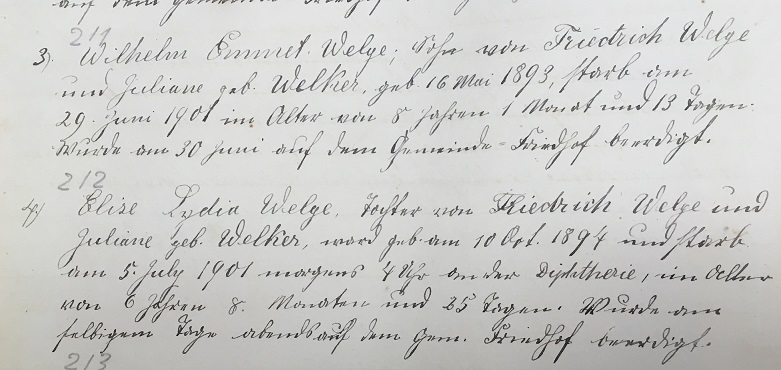
When Emmet was 8, & I was 6… We died before we could be given the antitoxin. But, one of our neighbors, the Logan family, had a son that had Diptheria at the same time and our doses of antitoxin saved him. When Emmet & I died in 1901, it was estimated that 20% of children under the age of 5 and adults, over the age of 40 who contracted Diptheria…died.
The Diptheria antitoxin was developed in the 1890's in Germany. Scientists grew the disease causing bacteria in a laboratory, waited for it to produce toxins and then harvested the toxin. I’m not sure exactly HOW they "harvested" the toxins… But, I'm pretty sure it was way more complicated than when our parents “harvested” corn or wheat in the fields.
Scientists then injected the toxins into horses. The horses weren’t harmed by the toxins, but they developed an immune response to fight the disease. Next, scientists took some of the antibody-rich blood from the horses to create the antitoxin serum used to treat humans. The antitoxin serum stopped the production of toxins and further development of the thick film that closed up a person’s airways… But, it didn’t keep people from contracting the disease and sometimes people even developed OTHER diseases from the antitoxin serum.
In October, 1901, a St. Louis physician, attended to a young girl named Bessie Baker, who was suffering from advanced Diptheria. As was his routine, he injected Diptheria antitoxin into the child and thinking antitoxin could be administered like a vaccine…as a preventive, even injected her 2 younger siblings. He told the parents when leaving that, “"she (Bessie) would soon be entirely well."
Four days later, the doctor was called back to the Bakers' home to a terrifying discovery: "There the little girl was suffering from tetanus (lockjaw). Nothing could be done for her. The poison was injected so thoroughly into her system that she was beyond medical aid." Bessie died of tetanus the following day, and her 2 siblings died within the week… So began one of the worst medical safety disasters in the history of American public health. By the time it was over, at least 13 children had died of tetanus they contracted from the contaminated antitoxin. Because of this, Congress passed the Biologics Control Act in 1902, giving our government its first regulation of antitoxin and later, the production of vaccines.
The Diptheria vaccine was created by Gaston Ramon in 1923. He discovered that when the Diptheria toxin was exposed to very small amounts of formaldehyde and heated, the toxin became non-toxic, and when injected would stimulate an immune response that would then protect people from becoming infected when they were exposed to the Diptheria bacteria.
Today, scientists continue to grow disease causing bacteria and virus particles in various laboratory animals, like horses, monkeys, mice, and pigs. There are many scientists today who have concerns that when these diseases are grown in animal tissues, we get not only the immune response to the targeted disease, but we also get some immune responses to EVERY disease to which the animals may have been exposed. I urge you to look into the "safety" of vaccines.
Well, that’s the end of your bacteria and virus science lesson for today.
Now I can put my little girl hat back on amd tell you more about my parents, Fritz and Juliana Welge. In 1902, the year after Emmet & me died, our Father and Uncle, Fritz and August exchanged homes. My parents and siblings moved from their home, known later as the Clarence and Adele Welge house on Hwy T…to the house on Paul Road where later their son, Alfred Welge lived. Now Ray & Dot Welge live on the farm.
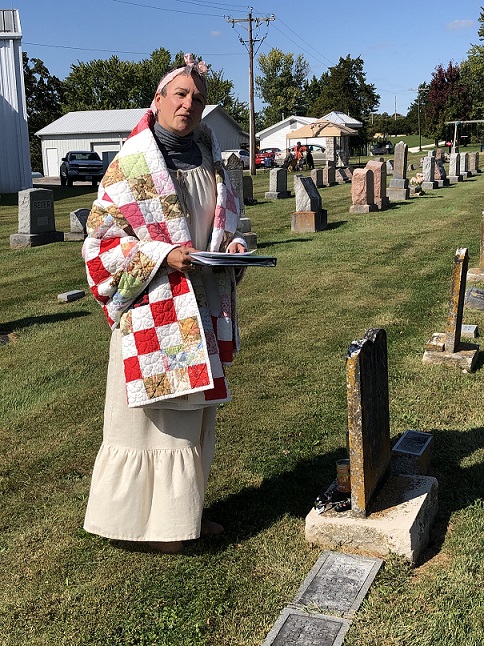
And I have one more thing to tell you about. See here, we have an older tombstone and a newer stone… Wanna know WHY the order of our first names different? Our names, as recorded in this church’s baptismal and death records, were "W. Emmet" and "Elsie Lydia". At the time the first stone was placed, it was a common German practice to refer to an individual by their 2nd (or middle) name. Over the years, as with many people in this cemetery, others would switch the order of their first and middle names when placing newer headstones… Thus, Emmet W. and Lydia E. Welge.
Family history source: Ray Welge, Gene Welge.
Source: https://artsci.case.edu/dittrick/2014/04/29/deadly-diphtheria-the-childrens-plague/ The 1901 St Louis Incident: The First Modern Medical Disaster, Ross E. DeHovitz, Pediatrics June 2014, 133 (6) 964-965; DOI: https://doi.org/10.1542/peds.2013-2817
 ,
,
German above, English below

Return to Family Page Cemetery List Cemetery Tour 2020
