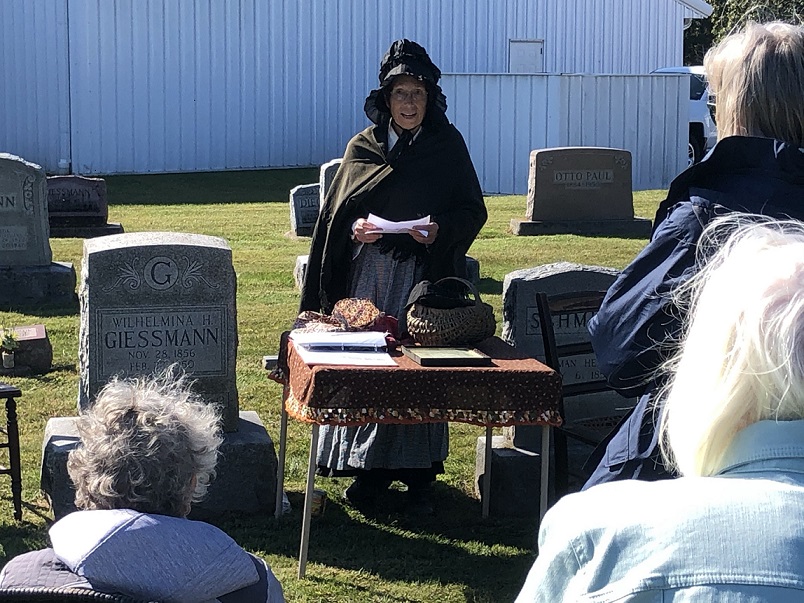
Wilhelmina Giessmann
as portrayed by Ruth Busdieker, her great granddaughter|
|
Wilhelmina Giessmann
as portrayed by Ruth Busdieker, her great granddaughter|
|
Mina Wilhelmina Giessmann
My name is Mina Giessmann I have a story to tell. My parents, Johann Heinrich & Maria
Sophia Paul, were born in Germany. My oldest
brother and sister were born in Germany. My parents lived near Cappeln, what was later
the Kenneth and Sidonia Paul farm, on Hwy T about 2 miles from here. My parents were the charter
members of this church. Someone else is telling their story today. My baptism was the first listed in the records at this church.
Baptisms were done in the home, by the Pastor.
After the Civil War I remember militia soldiers stopping at our house, I was around 9 years old, alone, and hid under the bed.
My parents and older siblings were in the field. The Militia solders took food for themselves, and oats
for their horses. They found money that was hidden in the kitchen and they took that too.
My parents raised oats, wheat, corn, cattle, and hogs. They usually took the animals to Foristell to sell,
however we also would drive the hogs over the frozen river to Washington.
I married August Freese a fellow
church goer, first we moved to Lincoln County. I was pregnant with my 2nd child, Dena, when we moved back to
New Melle, I would have to get off the rough wagon and walk at times. (1888) 130 years ago. One year later
my husband, August Freese, died. I had 2 children, George Freese, age 4, and Dena (Freese) Brakensiek, age 1.
Six years later, I, Mina, married a neighbor, August Giessman. Now, from my teenage son, Emmet's diary
(1916): "sold 1 gallon of coal oil for 10ȼ, to numerous neighbors". Coal oil (Coal oil is the same as
Kerosene) is the primarily fuel for lanterns, our only source of light at night. And stoves have a gallon
tank for Coal Oil to light 3 burners. Our family kept barrels, of coal oil, in a pump house, a small shed
with a wood floor keeping the barrels off the ground & away from the house. Many neighbors could not afford
a whole barrel of coal oil at one time, so they would just purchase a gallon at a time from us.
Other items in Emmet's diary: "I and neighbor put up telephone poles, papa went to telephone meeting, papa
put shades in school while I cleared the path, Sold furs 30 cents., hauled some logs from the woods to make a floor
over spring [source of water], we took automobile apart, I charged battery, papa started to make a tongue for
disk harrow. Drug the lane, went Hawk hunting with neighbor. Went to multiple funerals"
We had a bumper crop of apples one year. We dried them on the roof of the house, and a whole wagon load we
took to town and exchanged for 6 study wooden chairs with woven seats.
In 1920 at the age of 19, my son, Emmet, died of diphtheria/pneumonia, he was ill 5 days. We had to stay away
from other people for some time. Emmet was our only son. Eight months later we had an auction selling farm
equipment, and sold part of the farm "north of Foristell Road"
After my son died, my daughter Lydia drove us in our car to church, one time a fellow church goer asked "is
that safe?", in the 1920s, seldom would we see a female driving a car. In the twenty’s my son-in-law, Herman,
installed an inside water pump in the kitchen. It made cooking and cleaning so much easier. Ten years after
our only son died, my husband, August died on the way home from Wentzville. He was getting a rocking chair
for granddaughter Mabel. After that my daughter, Lydia and son in law, Herman came to live with me. They
had a neighbor care for their farm, so they could help me with mine.
After 1930, I wore mainly black, to remember my husbands and my son Emmet. My apron was blue and white checked.
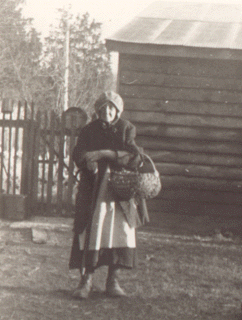
Daily I would use a basket to gather eggs from the chickens. Later years I'd used a cane in the other hand.
Grandaughter Mabel would be concerned, when I returned to the house with my blood on my hands as chickens
would peak at my hands occasionally.
We spoke Low German. All my children learned English in school. I learned to understand English, but
I still spoke German. Conversation in the house was always Low German. I would place cornbread in the
oven for breakfast as soon as I saw my daughter and husband come from the barn from milking the cows. At noon we
would have meat & usually a gemüse (potatoes cooked with green beans or cabbage) & pears. Sunday lunch was a
treat with peaches as the fruit. All of us would have 3:30p lunch bread and jelly. In my later years, I would
not eat supper with the family, instead I would have glass of eggnog with a little whiskey and read my German Bible
in my bedroom for the evening. I was in my 80's, when electricity came to the house in the mid 1940s. I passed,
reaching the age of 93, in 1950.
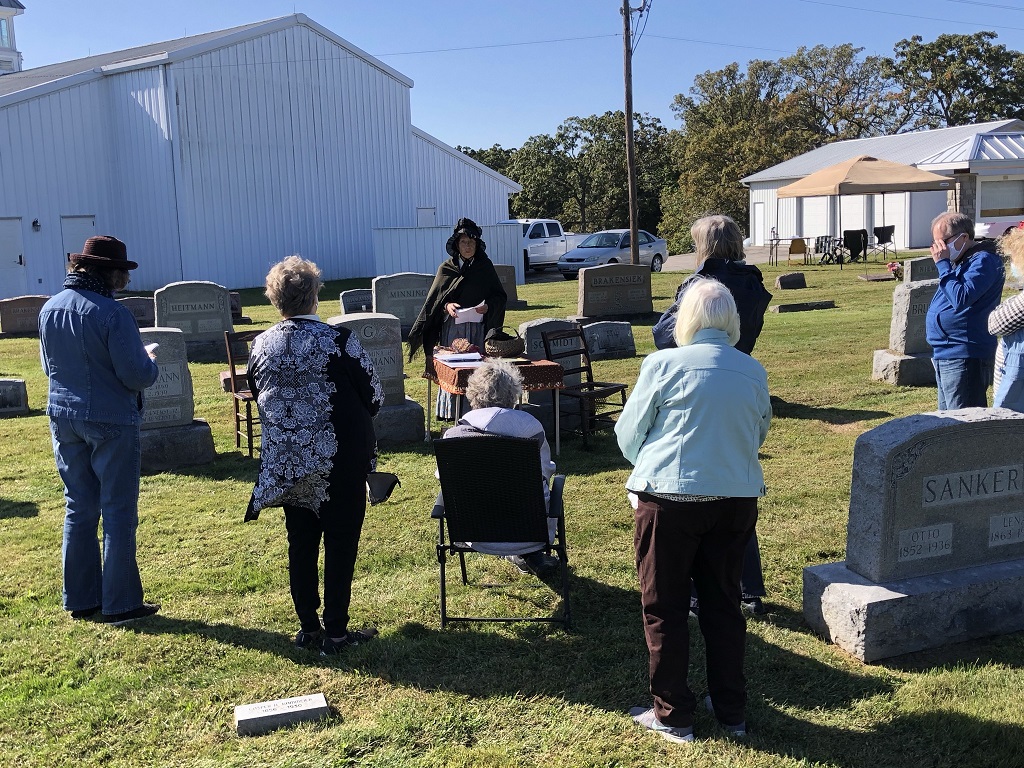
My actual name is Ruth Busdieker, I am one of Mina's 14 great grandchildren, and Mina has a 3-great granddaughter named Katelyn "Mina".
I had the pleasure to grow up in the house Mina road & walked to 130 years ago. I, Ruth, have enjoyed living with many of her things and pictures.
I have several displayed here. Her baptismal certificate. The chairs purchased with a load of dried apples. One of Mina's baskets that
she used to gather eggs, and a few Family photos, including Mina with her egg basket and cane walking from chicken house. I am wearing one of
her skirts, shawl, apron, and bonnet.
And fyi: we still have the wagon (we believe) Mina road & partially walked 130 years ago & that they used to take the dried apples to trade
for the 6 sturdy chairs – it has rubber tires now instead of wood, and the tong has been shortened.
Source: Oral history Lydia Freese, Mabel Busdieker [Mabel lived in the same house with Mina for 20 years, from the age of 3 (1930 to 1950)], Loyd Busdieker, diary of Emmet Giessman, and Wentzville Union Dec 31 1920
 |
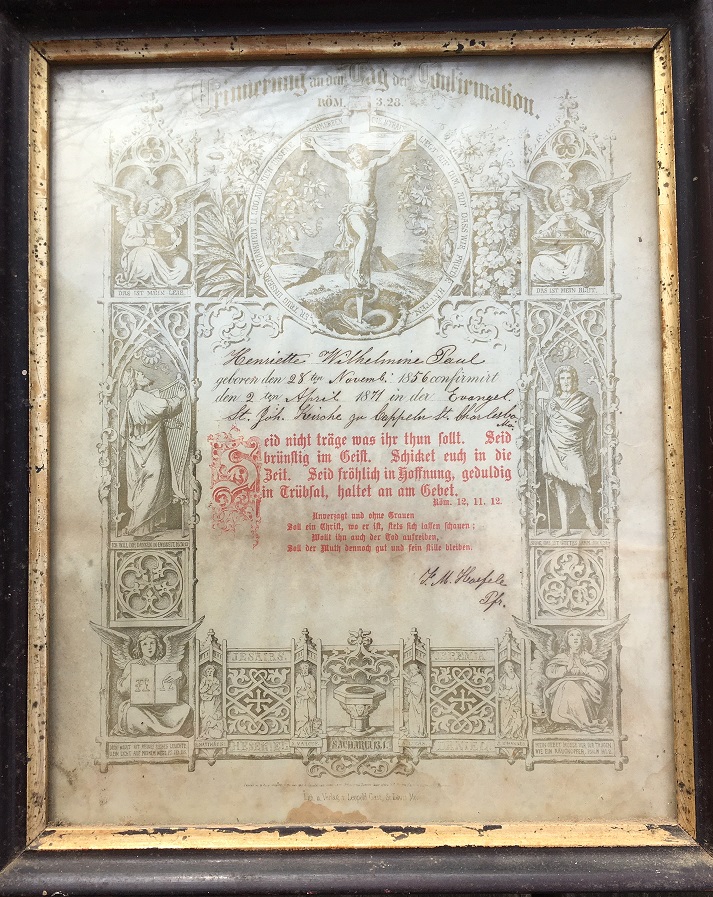 |
click on baptism certificate for larger and/or printable view
Return to Family Page Cemetery Records Cemetery Tour 2020