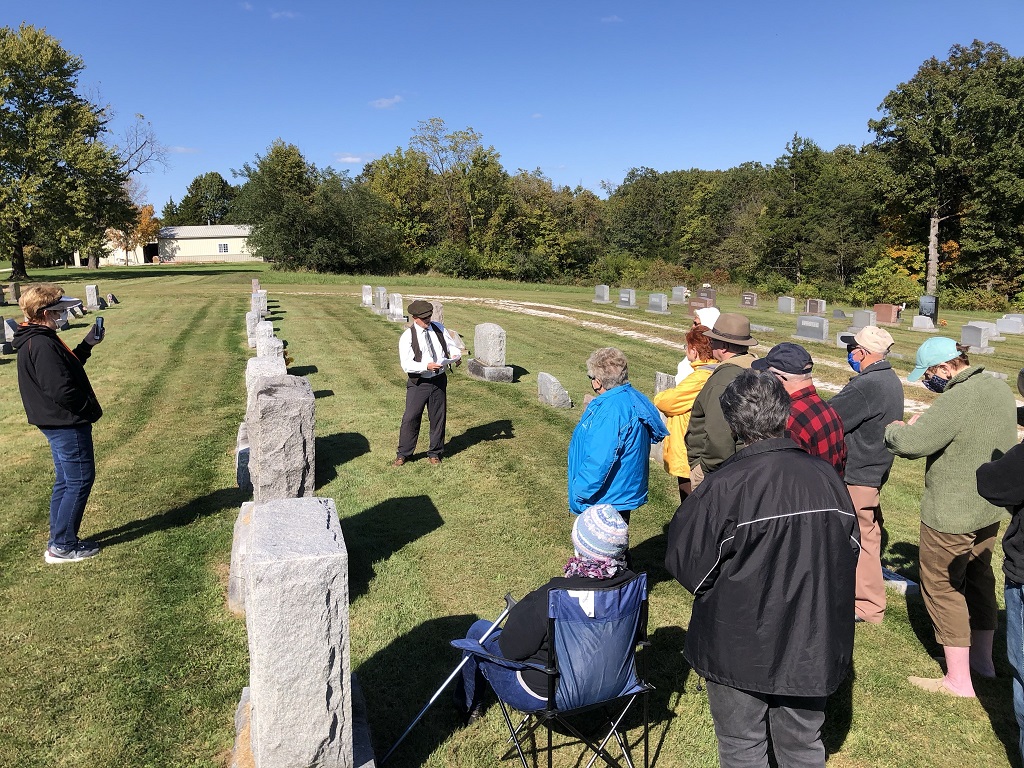
Ernst Dieckmann as portrayed by Wayne Raycraft
|
|
Ernst Dieckmann as portrayed by Wayne Raycraft
|
|
My name is Ernest Theodore Dieckmann, my parents were born near Koblenz, Germany. This was the northeastern part of Germany near the Rhine. My parents were Johann Friedrich and Hanna Fridericka Dieckmann. My baptism is recorded in the Femme Osage church In the 1860 census says there were 7 of us kids at home in Femme Osage township. This home was just in Warren County at the corner of TT, T, and D. - Firewood is split and sold there now.
I was a young unmarried man when the Civil War began. As you know, Missouri was in turmoil during the Civil War. Missouri ranks third among all the States with the most battles and engagements. Missouri does not lay claim to the likes of Gettysburg or a siege of Atlanta, but Missouri played host to both Union and Confederate views on a daily basis.
At the age of 22, I enlisted in Krekel’s Military in 1861 and mustered out in Jan 1862. For that reason, I have a second tombstone as shown here.
I served as a Private in the United States Reserve Corps. My Unit was Krekel's Battalion USRC Company E. One other person, Heinrich “William” Borgelt, in this cemetery has a stone saying he served in Krekel' Battalion. Mr. Borgelt&spos;s, grave is near the Old Sunday School Building. It is believed 13 people in this cemetery served in the Civil War.
You may ask what was Krekel's Battalion? Abraham Lincoln appointed Arnold Krekel as Provost Marshal for St. Charles, Warren, and Lincoln Counties. Civil War Provost Marshalls were the Union's Army officer which maintained order among both soldiers and civilians.
Let me say a few words about Arnold Krekel. Krekel came over from Germany with his family as a teenager settling in Dutzow. Krekel later studied law at St. Charles College. He was elected Justice of the Peace in 1841. In 1852, wins the race for a seat in Missouri’s House of Representatives, the first German to be elected to Missouri’s House. He had run a campaign using his newly created newspaper, Der Demokrat, which was the first German newspaper in St. Charles County. He was also a surveyor, important in starting towns, such as "O'Fallon", Krekel was a Corporal, his most striking act, was that he turned the St. Charles College, where he had attended and studied law, into a hospital for the Union Troops in December of 1862. Arnold Krekel in 1865, after the Civil Ware, serving as elected President of the Missouri Constitutional Convention signed Missouri’s Emancipation Proclamation thereby ending the enslavement of all African American's in Missouri.
Back to me, Ernst, my marriage to Karoline Fulling is in the records of this church. The marriage did not occur in this Church, as this building was not finished until after the Civil War in 1865. I, Ernst, was a farmer, as was my father in Germany. In 1885, I, Ernst owned 400 acres. As I look back, I have spent 82 years on this earth, living in Missouri, I saw first-hand the Civil War, and now we have gone thru a World War. Maybe war will end.
Thank you for listening to my story.
Another Dieckman has been very important to this cemetery is Ray Dieckman. Why? For 16 years, prior to 2003, Ray Dieckman, not a descendant, mowed this cemetery and grounds at this church. At that time, the minister and wife did mow their part. Ray Dieckman accepted no pay. Let me repeat this he mowed it for 16 years. His son Craig did help him at times. Besides mowing the grass, as new graves would sink some, he would fill in the dirt with wheelbarrow and shovel, and reseeded. He volunteered his time.
There has been many others who donated their time to maintain this cemetery, for that we all should appreciate. I want you to look around this cemetery, I am sure many of you mow grass and realize the difficulty in mowing around all the tombstones. Just take a moment and reflect, the next time you place a flower or memorial item on the tombstone, please be sure you place that flower or item on the tombstone. It is so much easier for the grounds keeper to mow the cemetery, keeping it nice, if the flower or item is on, or least flush, with the tombstone. Mowing grass in a cemetery takes skill, a wrong knock from a large mower could easily chip the older stones, cause it to lean or knock the tombstone over.
Thank you for listening.
Source: The Civil War In Missouri: Day by Day 1861 – 1865, p. 1 Carolyn M. Bartels: 1860 U.S. Federal Census page33, house 255-250
Return to Family Page Cemetery List Cemetery Tour 2020